Consumer Sentiment Index
Baghdad's Consumer Confidence Just Hit the Floor
665 Baghdad residents surveyed during Ramadan on economic outlook, personal finances, and spending confidence. The index scored 35.7 out of 100, down 23 points from the Ipsos Q4 2024 baseline. We break down what moved and why.
Consumer confidence in Baghdad has collapsed.
Our Consumer Sentiment Index came in at 35.7 out of 100. The index works like a thermometer: 50 is the neutral line. Above it, more people feel good than bad about the economy. Below it, the opposite. The last comparable reading, the Ipsos Iraq Consumer Sentiment Index from Q4 2024, stood at 58.5. That is a drop of nearly 23 points, from cautious optimism to deep pessimism.
The index has three components.
Economic Expectations (42.3) captures where people think the economy is headed.
Investment Climate (34.6) captures how comfortable people feel making purchases and setting aside savings.
Personal Financial Conditions (33.1) captures how people assess their own financial situation today.
Q4 2024 | Q1 2026 | Change | |
|---|---|---|---|
Overall CSI | 58.5 | 35.7 | -22.8 |
Economic Expectations | 66.1 | 42.3 | -23.8 |
Investment Climate | 54.4 | 34.6 | -19.8 |
Personal Financial Conditions | 50.8 | 33.1 | -17.7 |
We asked 13 questions about the economy, personal finances, and willingness to spend. Each chart below compares our Q1 2026 results against the Ipsos Q4 2024 baseline. Every line moved in the wrong direction.
What Happened
Two shocks landed on Baghdad in quick succession. Together they explain why consumer confidence fell so far so fast.
The Tariff Shock
On January 1, 2026, the government replaced Iraq's old customs duties, a flat 1–5% on almost everything, with a new system charging 0.5% to 30% across 16,400 product categories. Infant formula duties rose sixfold. Medicine prices climbed 15–25% at the pharmacy counter. Gold import duties surged 48 times over, killing the gold trade outright.
The government's reason was simple: Iraq collected about $1 billion in customs revenue on $70 billion in imports, a collection rate that pointed to vast evasion. But the sudden rollout hit merchants hard. On February 8, the Iraqi Traders Association shut down markets nationwide with full compliance. 76,000 containers sat uncollected at ports. Truck traffic at the Jordanian border fell to 15% of normal.
The War and Hormuz
On February 28, the US and Israel struck Iran. Iran struck back across the Gulf. The Strait of Hormuz, the route for roughly 90% of Iraq's government revenue, closed. Tanker traffic dropped from 24 ships a day to zero. Iraq shut Rumaila, its largest oil field, which produces 1.5 million barrels a day, roughly 36% of the country's output. The estimated cost: $6–7 billion in lost revenue each month. Iraq's only other export route, the pipeline to Turkey, has been out of service since March 2023.
The energy picture compounds the problem. Iraq gets roughly 30% of its electricity from Iranian gas. Iran had already cut 85% of gas deliveries before the war. Summer demand will peak at 37–46 GW against about 28 GW of available capacity.
Economic Outlook
How do Baghdad residents rate the economy today, and where do they think it is headed?
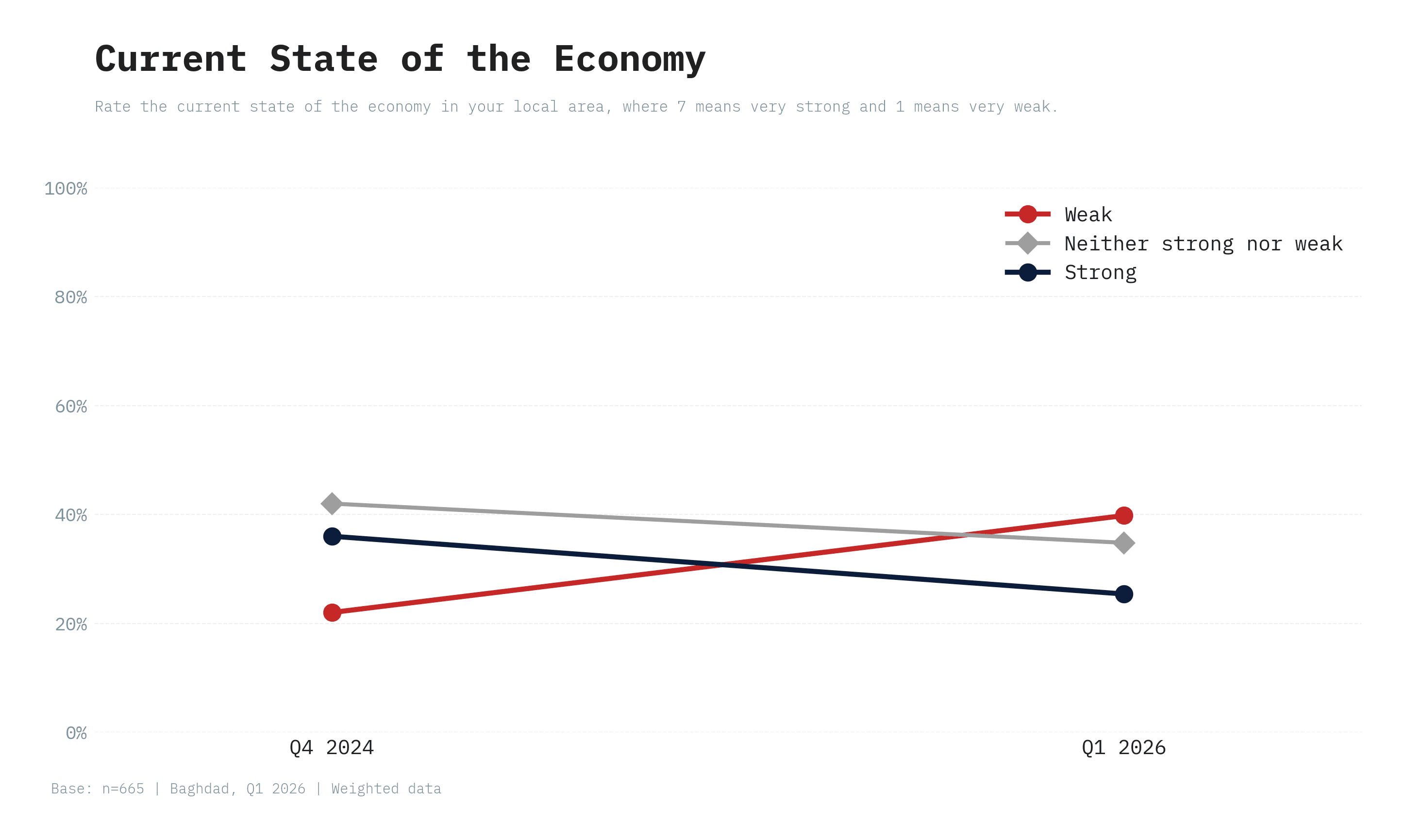
In Q4 2024, 36% rated the economy as strong and 22% rated it weak. Those lines have crossed. Now 40% say the economy is weak and only 25% say it is strong. The share sitting in the middle shrank too, from 42% to 35%. People are moving from undecided to pessimistic.
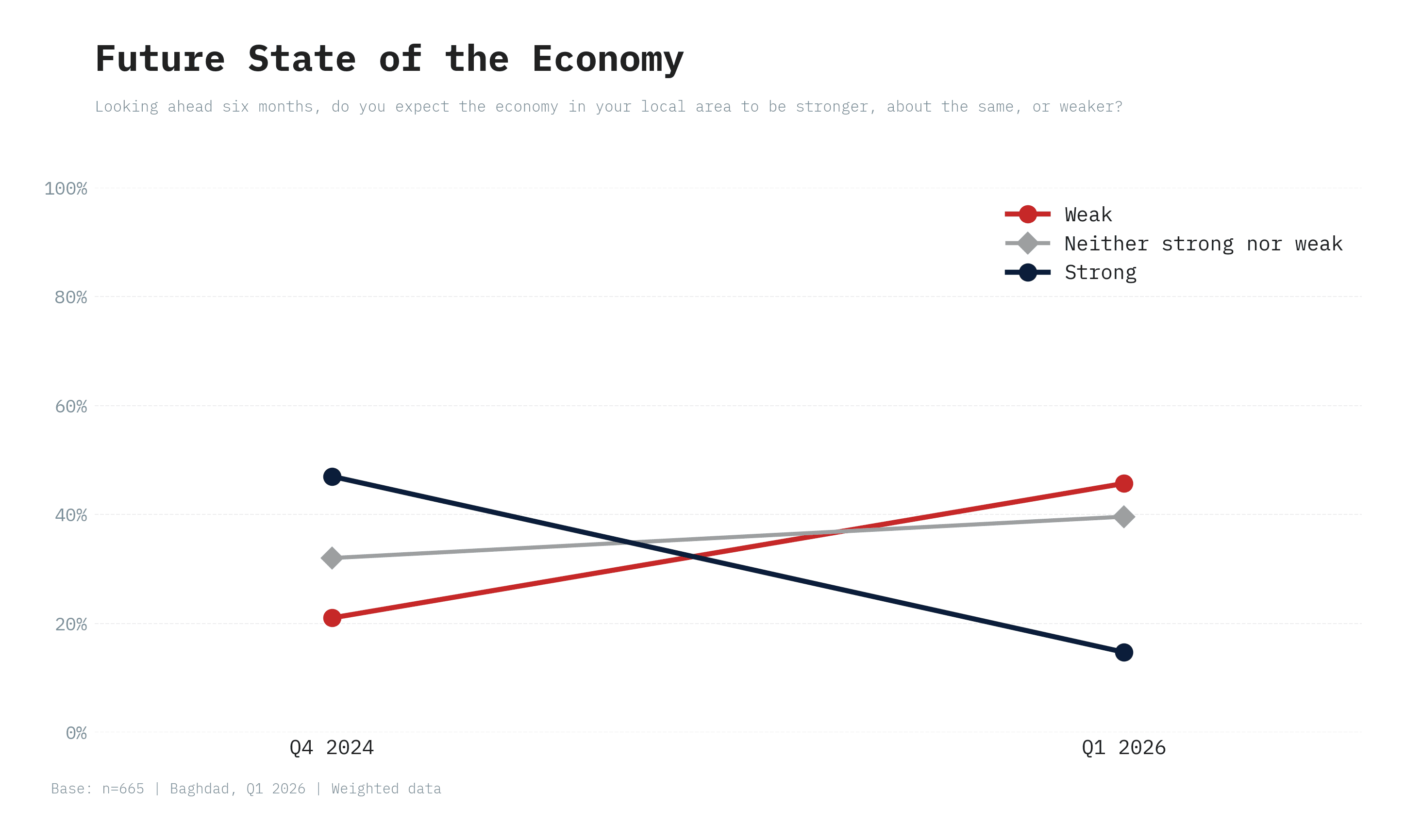
The forward-looking picture is worse. In Q4 2024, 47% expected the economy to strengthen over the next six months. Now it is 15%. The share expecting the economy to weaken more than doubled, from 21% to 46%. This is the sharpest swing of any question in the study. When we asked separately about confidence in economic stability, 74% said they have little or none.
Personal Finances
How do people feel about their own money?
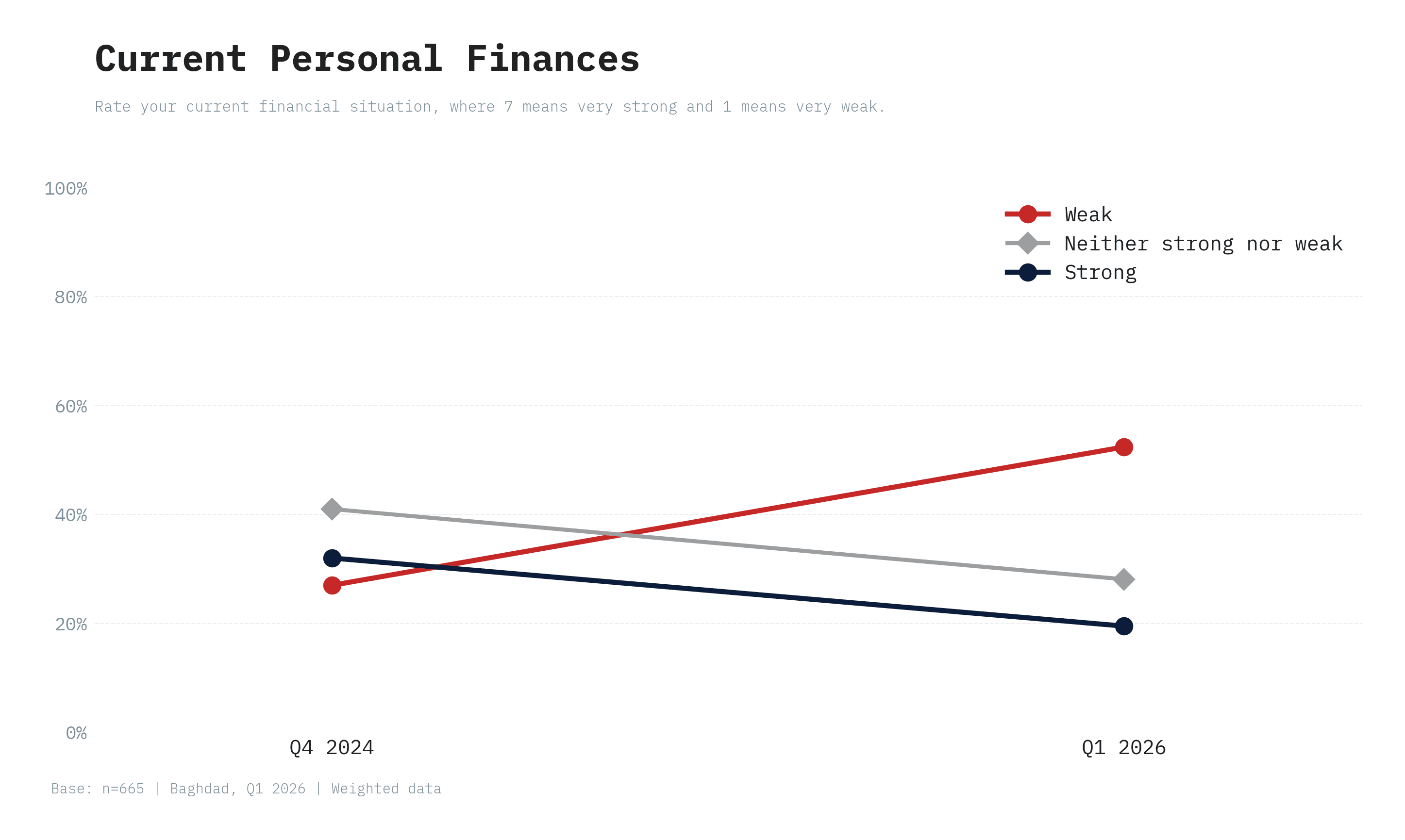
Current personal finances show the most dramatic crossover of any question. In Q4 2024, the split was roughly balanced: 32% strong versus 27% weak. Now it is 20% strong versus 52% weak. More than half of Baghdad residents rate their own financial situation as weak. The neutral middle has thinned from 41% to 28% as people pick a side, and most pick the negative one.
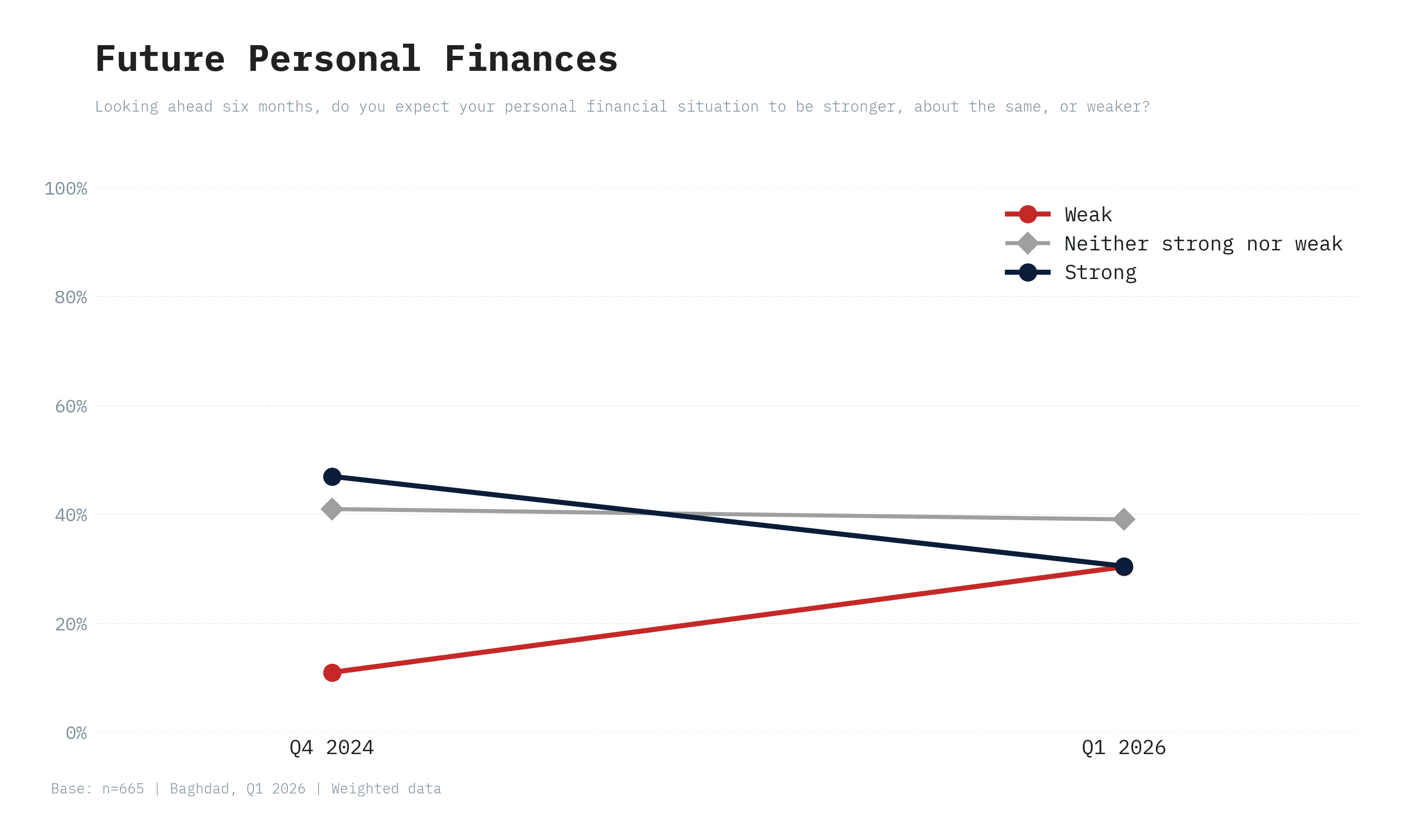
Personal financial outlook is the one area where the lines converge rather than cross. The "strong" line dropped from 47% to 31%, and the "weak" line rose from 11% to 30%, but they meet in the middle rather than swapping. This question produces the only sub-index score near neutral (50.1). Even as people say the economy is broken and their current finances are weak, a narrow plurality expect their own situation to hold steady or improve slightly.
Spending Confidence
Are people willing to spend?
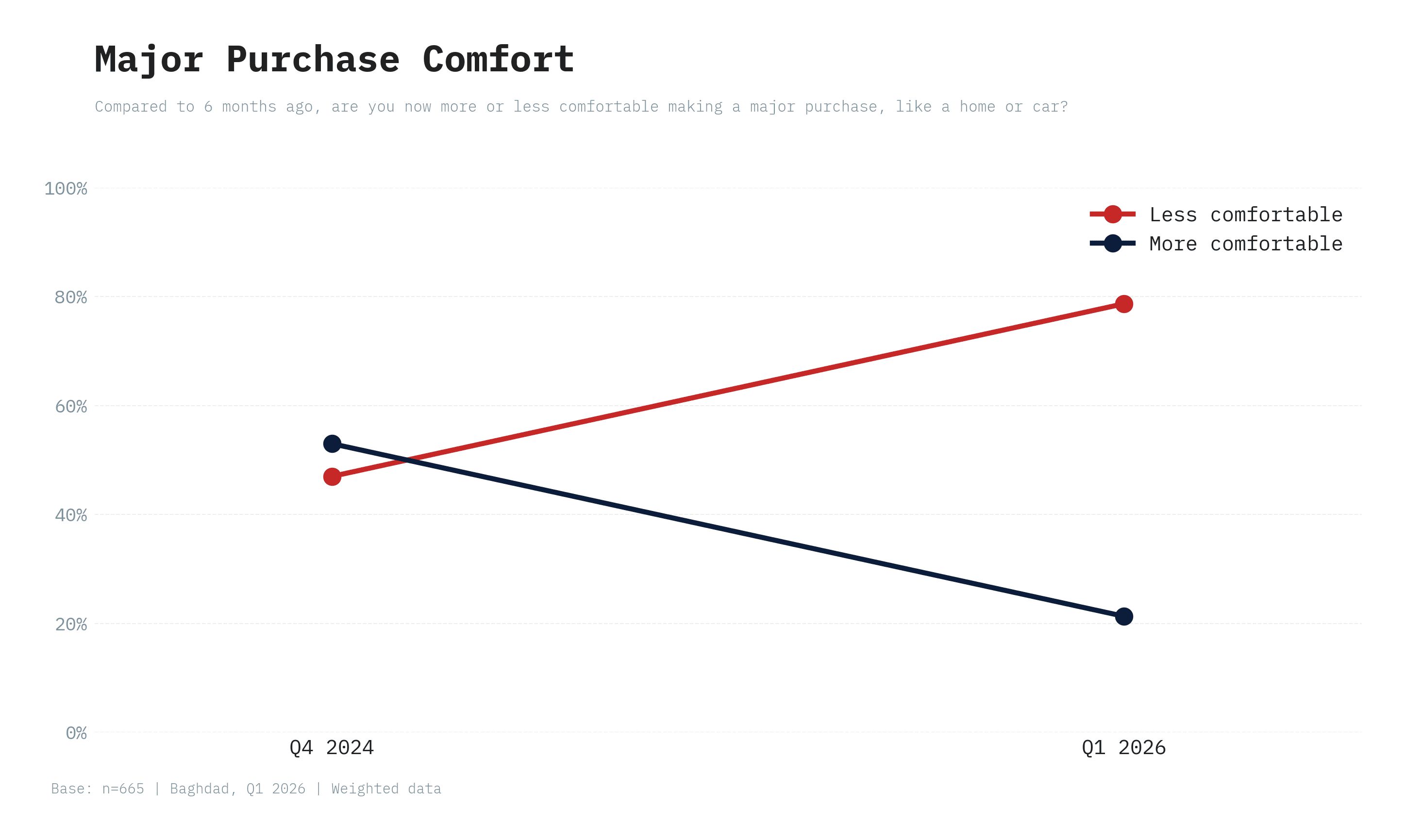
Major purchase confidence has collapsed. In Q4 2024, 53% said they were more comfortable buying a home or car. Now it is 21%. The lines have swapped completely: 79% say they are less comfortable. Willingness to make big-ticket purchases has essentially evaporated.
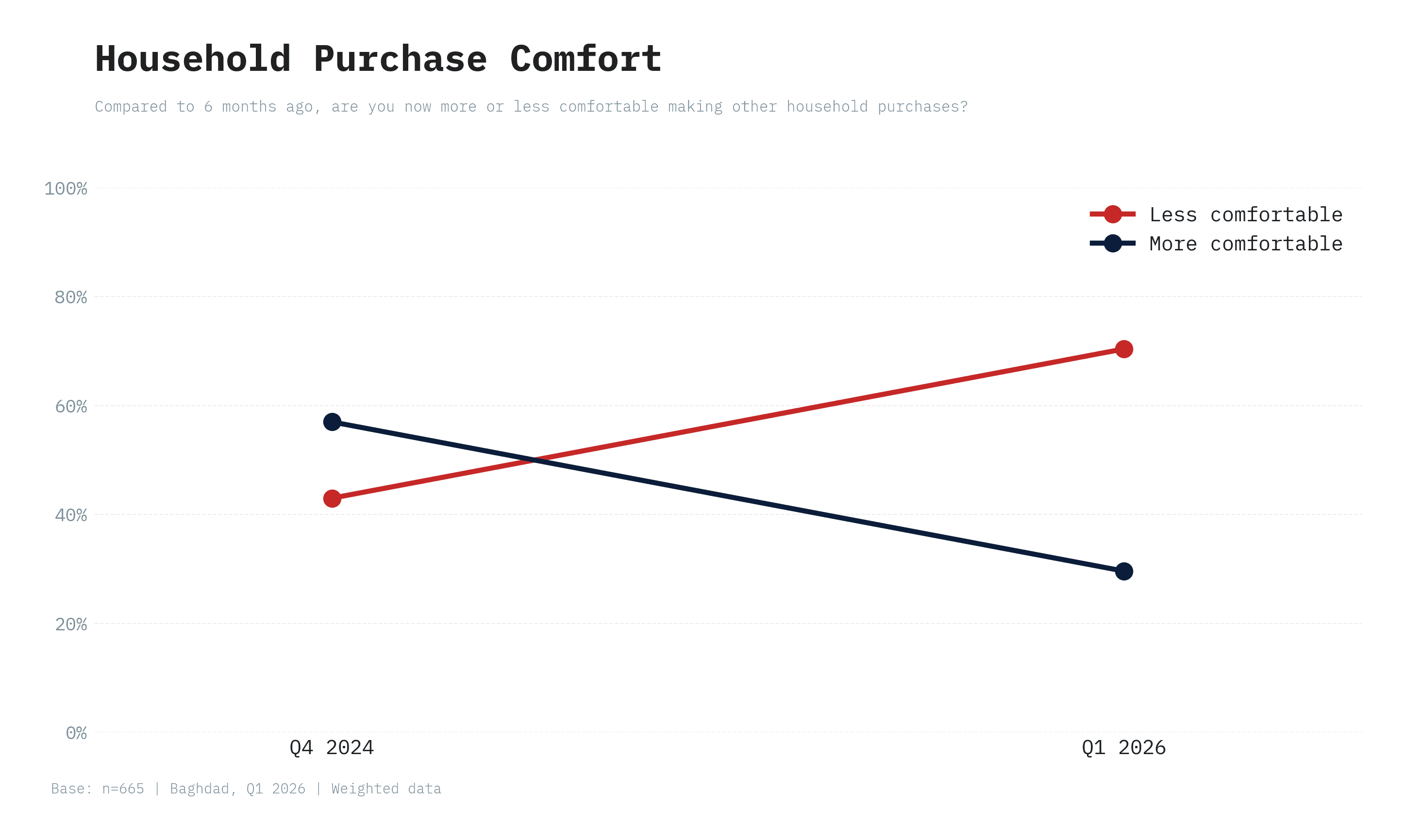
Everyday household spending tells the same story, slightly less extreme. "More comfortable" dropped from 57% to 30%. "Less comfortable" rose from 43% to 70%. When seven in ten people say they feel worse about buying groceries and household goods, it signals a pullback that touches every market in the city.
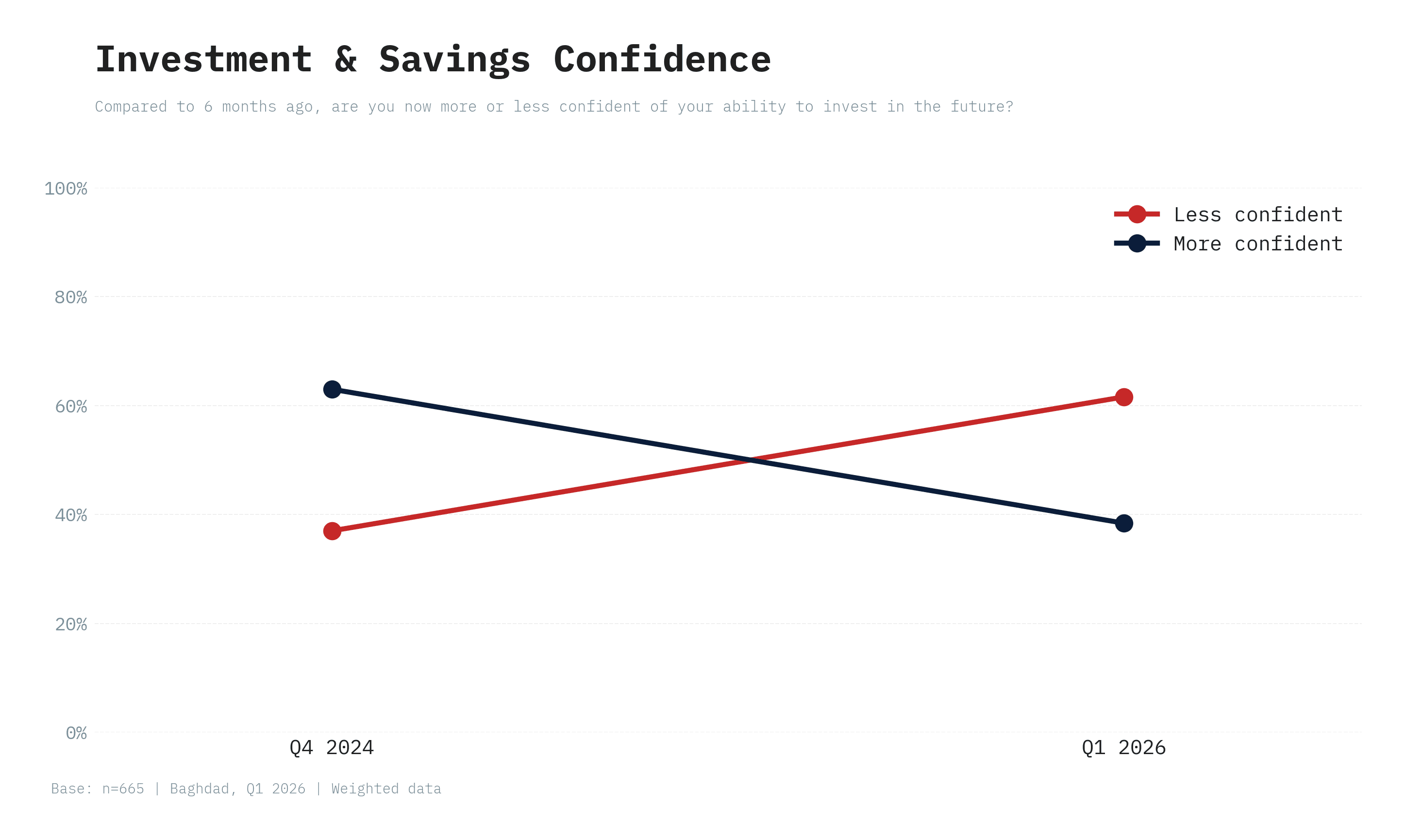
Investment and savings confidence follows the same pattern. "More confident" dropped from 63% to 38%. "Less confident" rose from 37% to 62%. People who feel less confident about saving and investing are spending defensively, focused on getting through today rather than building for tomorrow.
Taken together, these three charts show a consumer base that has pulled back across the board. 63% of respondents say they have already cut their spending. Only 13% have spent more. Whether prices drove the pullback or fear did, the outcome for Baghdad's economy is the same.
Our Methodology
665 Baghdad residents surveyed online during the second week of Ramadan 2026 (March 8–14), drawn from the 46 Million consumer panel.
Split between Karkh and Rusafa. 63% male, 37% female. Weighted by gender and age group to match Iraq Census 2024 and UN population estimates.
13 questions in Arabic covering economic outlook, personal finances, spending comfort, tariff impact, and conflict effects. The index uses a diffusion method on a 0–100 scale where 50 is neutral.
Got a question about Iraq? We'll get you the answer.
46 Million is Iraq's first consumer research panel, a research product from The Engine. We currently cover Baghdad and are expanding rapidly across Iraq. Future waves of this study will extend to Basra, Erbil, and Mosul. If you have a specific question or want analysis for your brand or client, we can run custom studies in days and deliver insights segmented by age, gender, district, income, or behavior.
The Engine runs research, strategy, and consulting projects across Iraq. If your question goes beyond survey data, we can help there too.
Get in touch: Mustafa@the-engine.ai